




The Bragg’s Law: Derivation, Formula, & Physics Notes
Published by Educationallof | Solid State Physics Series – Bragg’s Law in Physics
Introduction to Bragg’s Law
We study crystal structure through the diffraction of photons, neutrons, and electrons. Diffraction depends directly on the crystal structure and on the wavelength of the incident radiation.
Optical vs. X-ray Wavelengths:
- At optical wavelengths (such as 5000 Å), the superposition of waves scattered elastically by individual atoms of a crystal results in ordinary optical refraction.
- When the wavelength of the radiation is comparable with or smaller than the lattice constant, diffracted beams appear in directions quite different from the incident direction.
Concept of Specular Reflection & Interference
The Bragg derivation is simple but convincing because it accurately reproduces the correct experimental result.
- Suppose incident waves are reflected specularly from parallel planes of atoms in the crystal, with each plane reflecting only a very small fraction of the radiation (like a lightly silvered mirror).
- In specular (mirror-like) reflection, the angle of incidence is equal to the angle of reflection.
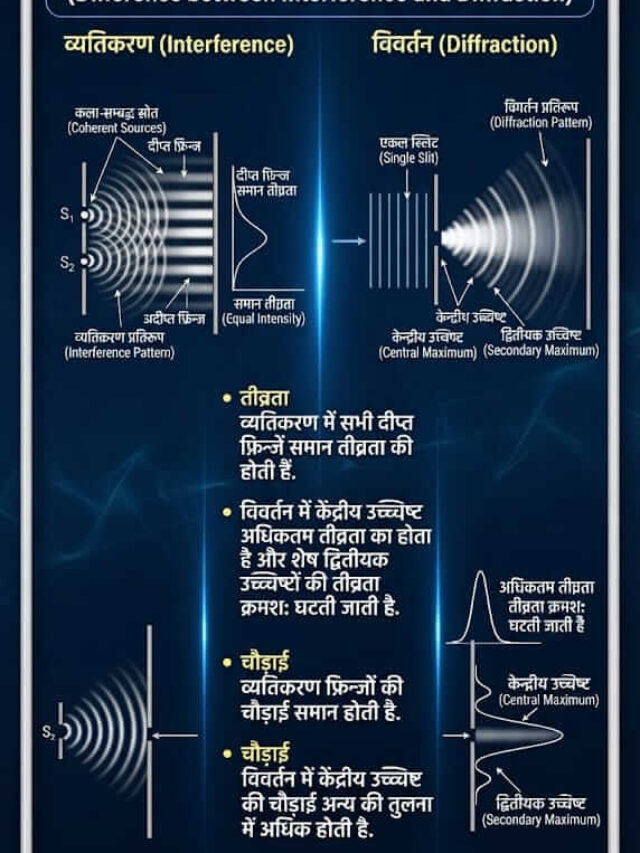
- The diffracted beams are formed when reflections from parallel planes of atoms interfere constructively.
- We treat elastic scattering, in which the energy (and wavelength) of the X-ray is not changed upon reflection.
Derivation & Equation of Bragg’s Law
Consider parallel lattice planes spaced a distance d apart. The radiation is incident in the plane of the paper at an angle θ measured from the plane.
The path difference for rays reflected from adjacent planes is 2d sin θ.
Constructive interference of the radiation from successive planes occurs when this path difference is equal to an integral number n of wavelengths:
2d sin θ = nλ
(Equation 1: Bragg’s Law of Diffraction)
Limiting Condition for Diffraction: Bragg’s law can be satisfied only when the wavelength satisfies:
λ ≤ 2d
This explains why visible light (whose wavelength is much larger than lattice spacing d) cannot be diffracted by crystals.
Important Characteristics & Physics Insights
- Multi-Plane Reflection Contribution: If each plane were perfectly reflecting, only the first plane would see the radiation, and any wavelength would be reflected. However, each plane reflects only 10-3 to 10-5 of the incident radiation. Thus, about 103 to 105 planes contribute to the formation of the Bragg-reflected beam in a perfect crystal.
- Surface Physics vs. Bulk Physics: Reflection by a single plane of atoms is treated in surface physics, whereas Bragg reflection involves bulk lattice periodicity.
- Periodicity vs. Basis Composition: Bragg’s law is a direct consequence of the periodicity of the lattice. It does not depend on the composition of the basis of atoms associated with each lattice point.
- Diffraction Order & Intensity: Although the law position does not depend on atom basis, the composition of the basis determines the relative intensity of the various orders of diffraction (denoted by n) from a given set of parallel planes.
Important Questions and Answers: Bragg’s Law
Q1. What is Bragg’s Law in Physics? (ब्राग का नियम क्या है?)
Answer: Bragg’s Law explains the condition for constructive interference of radiation (like X-rays) diffracted from parallel lattice planes of a crystal. It is expressed by the formula: 2d sin θ = nλ.
Q2. What do the terms in the equation 2d sin θ = nλ represent?
Answer:
- d: Interplanar spacing between adjacent crystal lattice planes
- θ (Theta): Bragg angle (Glancing angle of incidence)
- n: Order of diffraction (an integer: 1, 2, 3…)
- λ (Lambda): Wavelength of the incident radiation
Q3. Why cannot ordinary visible light be diffracted by crystal lattices?
Answer: Bragg’s law is satisfied only when λ ≤ 2d. Visible light has a much larger wavelength (e.g., ~5000 Å) compared to the interplanar spacing of crystals (a few Angstroms), resulting in ordinary optical refraction instead of diffraction.
Q4. What is Specular Reflection in the context of Bragg’s Law?
Answer: Specular (mirror-like) reflection means the angle of incidence is equal to the angle of reflection from parallel atomic planes, with each plane reflecting a tiny fraction (10-3 to 10-5) of the incident radiation without changing its energy (Elastic Scattering).
Q5. Does Bragg’s Law depend on the atomic basis of the crystal?
Answer: No, the position of Bragg reflections depends strictly on the periodicity of the lattice. However, the composition of the atomic basis determines the relative intensity of the various diffraction orders (n).
Q6. How many atomic planes contribute to the Bragg-reflected beam?
Answer: Since a single plane reflects only 10-3 to 10-5 of the incident beam, approximately 103 to 105 parallel planes contribute together to produce a strong Bragg-diffracted beam in a perfect crystal.
Learn more –
Ripple Counter in Digital Electronics: Working, Truth Table & Types
आवेश संरक्षण का नियम (Conservation of Charges): सिद्धांत, उदाहरण और मुख्य विशेषताएँ
त्रिकोणमिति के महत्वपूर्ण सूत्र (Advanced Formulas): sin(A+B), 2θ, 3θ | Educationallof
सदिश और अदिश राशियाँ: परिभाषा, मात्रक, विमा और महत्वपूर्ण सूत्र | Mathematics Notes
घर्षण विद्युत् क्या है? इतिहास, परिभाषा और महत्वपूर्ण तथ्य | Frictional Electricity in Hindi















Join Our Physics Community!
Latest Physics Notes, PGT/NET Prep & Daily MCQs directly on your WhatsApp.
100% Private & Secure | No Phone Number Required