












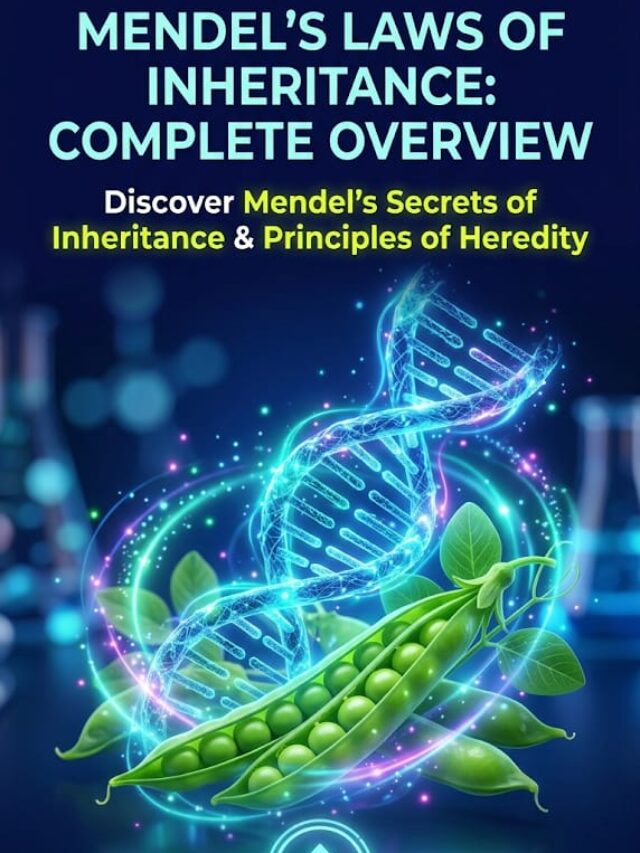
Mendel’s Laws of Inheritance: Complete Overview & Principles
Fundamental Concepts of Genetics, Principles of Heredity, and Experimental Findings
1. Introduction to Mendelian Genetics
In the middle of the nineteenth century, a major breakthrough was achieved in understanding the mechanisms of heredity. Gregor Johann Mendel, often hailed as the “Father of Modern Genetics,” conducted pioneering hybridization experiments on garden pea plants (Pisum sativum) over a continuous seven-year period from 1856 to 1863.
Based on his meticulous observation and data analysis, Mendel proposed the fundamental principles of inheritance in living organisms, setting the cornerstone for modern genetic science.
2. Scientific Methodology & Experimental Precision
Mendel’s approach differed significantly from previous biologists due to his rigorous mathematical and statistical approach to biological investigation:
- Mathematical Logic & Numerical Analysis: Mendel was among the earliest scientists to apply quantitative, mathematical logic and statistical analyses to solve complex biological problems.
- Large Sample Size: He analyzed a vast number of plant samples across successive generations, which minimized experimental error and provided high statistical credibility to his findings.
- Confirmation Across Generations: His experiments were performed systematically over several successive generations to confirm that the observed inheritance patterns were consistent and predictable.
3. True-Breeding Lines & Artificial Hybridization
Mendel utilized artificial pollination (cross-pollination) techniques on true-breeding (pure line) pea plants.
What is a True-Breeding Line? A true-breeding line is one that has undergone continuous self-pollination for multiple generations, displaying stable, permanent trait inheritance without unexpected variation in offspring.
Mendel selected 14 true-breeding pea plant varieties, which formed 7 pairs of contrasting traits that were identical except for one specific characteristic.
4. The 7 Pairs of Contrasting Traits Studied by Mendel
Mendel deliberately selected traits that presented clear, opposing phenotypic expressions:
| Plant Character | Dominant Trait | Recessive Trait |
|---|---|---|
| 1. Stem Height | Tall | Dwarf |
| 2. Seed Shape | Round / Smooth | Wrinkled |
| 3. Seed Color | Yellow | Green |
| 4. Pod Shape | Inflated (Puffed) | Constricted (Shrunk) |
| 5. Pod Color | Green | Yellow |
| 6. Flower Color | Violet / Purple | White |
| 7. Flower Position | Axial | Terminal |
5. The Fundamental Laws of Mendelian Inheritance
Through his monohybrid and dihybrid cross experiments, Mendel formulated three foundational principles of inheritance:
I. Law of Dominance
States that in a heterozygote, one trait will conceal the presence of another trait for the same characteristic. The allele that is expressed is called dominant, while the masked allele is recessive.
II. Law of Segregation (Purity of Gametes)
States that during the formation of gametes (meiosis), the two alleles for a trait segregate from each other so that each gamete carries only one allele for each gene.
III. Law of Independent Assortment
States that alleles of two or more different genes assort independently of one another during gamete formation, provided the genes are on different chromosomes or far apart on the same chromosome.
Summary & Key Takeaways
- Gregor Mendel discovered the basis of genetic inheritance using Pisum sativum (1856–1863).
- He applied quantitative analysis, using large sample sizes and 14 true-breeding varieties (7 pairs of contrasting traits).
- Mendel’s work established the foundation for modern genetics, later expanded by modern geneticists to explain complex inheritance patterns.
Practice Questions & Answers: Mendel’s Laws of Inheritance
Important Exam-Oriented MCQs, Short & Detailed Questions for Biology Students
Section A: Multiple Choice Questions (MCQs)
Q1. For how many years did Gregor Mendel conduct experiments on garden pea plants?
- (a) 5 years (1850–1855)
- (b) 7 years (1856–1863)
- (c) 10 years (1860–1870)
- (d) 14 years (1856–1870)
Q2. How many pairs of contrasting traits did Mendel study in garden pea plants?
- (a) 5 pairs
- (b) 12 pairs
- (c) 7 pairs
- (d) 14 pairs
Q3. Which of the following is a recessive trait in pea plants according to Mendel’s experiments?
- (a) Tall stem height
- (b) Yellow seed color
- (c) Wrinkled seed shape
- (d) Green pod color
Section B: Short Answer Questions
Q1. What is a true-breeding line in Mendelian genetics?
Answer: A true-breeding line is one that has undergone continuous self-pollination over several generations and shows stable, constant trait inheritance. Offspring produced by a true-breeding plant consistently express the same phenotype without unexpected variations.
Q2. Why was Mendel’s mathematical approach revolutionary for biological sciences?
Answer: Mendel was one of the first scientists to integrate mathematical logic, numerical analysis, and statistical probabilities into biological research. His use of large sample sizes provided high credibility and statistical validity to his laws of inheritance.
Q3. State Mendel’s Law of Segregation.
Answer: The Law of Segregation states that during gamete formation (meiosis), allele pairs segregate so that each gamete carries only one allele for each gene pair. This ensures that gametes are always pure for a given trait.
Section C: Comprehensive / Long Questions
Q1. Explain why garden pea (Pisum sativum) was an ideal choice for Mendel’s hybridization experiments.
Answer: Mendel selected garden pea plants due to several distinct advantages:
- Clear Contrasting Traits: Pea plants possessed distinct, easily observable contrasting characters (e.g., tall vs. dwarf, round vs. wrinkled seeds).
- Short Life Cycle: Pea plants complete their life cycle quickly within a single season, allowing data collection across multiple generations in a short time.
- Controlled Breeding: Flowers are naturally self-pollinating, but artificial cross-pollination (hybridization) can be easily performed by emasculation and bagging.
- High Fertility: A single cross produces a large number of seeds, enabling reliable statistical analysis.
Q2. Differentiate between Dominant Traits and Recessive Traits with examples.
| Feature | Dominant Trait | Recessive Trait |
|---|---|---|
| Expression | Expressed in both homozygous (TT) and heterozygous (Tt) conditions. | Expressed only in homozygous (tt) condition. |
| F1 Generation | Appears in the F1 hybrid generation. | Remains hidden or masked in the F1 hybrid generation. |
| Examples | Tall stem height, Round seed, Yellow seed. | Dwarf stem height, Wrinkled seed, Green seed. |
💡 Exam Tip for Genetics Notes
Always remember the contrasting traits for seed color and pod color! For seed color, Yellow is dominant over Green. For pod color, Green is dominant over Yellow. This distinction is frequently asked in competitive exams like CTET, PGT, and
CSIR-NET.
Learn more –
Plant Tissues & Tissue Culture Notes: Classification, Types & Functions | educationallof
Essay on My Hobby (100, 200, 500 & 1000 Words in English)
Essay on Mahatma Gandhi: Life, History, Philosophy & Freedom Struggle
Bragg’s Law: Derivation, Formula, Condition & Applications | Educationallof
Ripple Counter in Digital Electronics: Working, Truth Table & Types
Mendel’s Laws of Inheritance
Play quiz here 👇👇


















Mendel’s Laws of Inheritance

Join Our Physics Community!
Latest Physics Notes, PGT/NET Prep & Daily MCQs directly on your WhatsApp.
100% Private & Secure | No Phone Number Required